Water-cooled Hose: The Flexible Fluid Transport Core of Modern Precision Cooling Systems
2026-08-28 14:14:50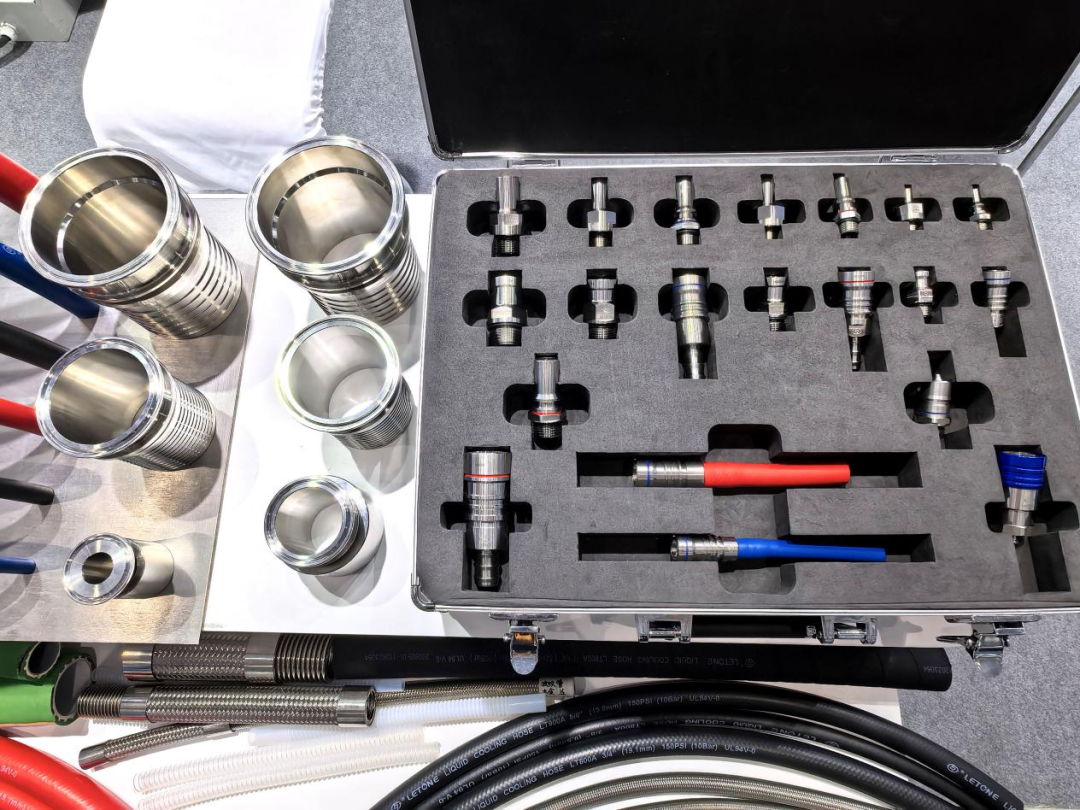
Solving the Pain Points of Long-Term Installation and Maintenance of Rigid Water-cooled Piping
In scenarios requiring precise temperature control, such as industrial equipment, data centers, and new energy storage, traditional rigid metal water-cooled piping has always faced unavoidable adaptation challenges: slight vibrations during equipment operation easily lead to stress concentration in rigid pipe connections, resulting in cracks and leaks at welds or joints after long-term operation; simultaneously, rigid piping requires extremely high installation precision, and even minor adjustments to the equipment layout necessitate custom-making and processing of the entire piping system, resulting in high modification costs and long lead times. The emergence of water-cooled hoses specifically addresses these three core performance barriers: flexibility, vibration reduction and noise reduction, and ease of installation and maintenance. It has become the core flexible transport link connecting the cold source and heat source in various precision water-cooling systems, significantly improving the operational reliability and deployment flexibility of the entire water-cooling system.
Multi-layer Composite Structure Design Logic for All-Scenario Adaptability
The performance design of this water-cooled hose is optimized to meet the universal usage needs of various water-cooling systems. The inner tube is made of low-leaching, high-cleanliness food-grade or industrial-grade special polymer materials, ensuring long-term stable compatibility with various water-cooling media such as pure water, ethylene glycol coolant, and deionized water. Long-term operation will not result in scale buildup on the inner wall or particle shedding that clogs the cooling plates or water cooling heads, guaranteeing the long-term cleanliness of the entire water-cooling circuit. The intermediate reinforcing layer uses a high-strength synthetic fiber or stainless steel wire interwoven structure, ensuring a rated pressure capacity ranging from 1.0MPa to 2.5MPa while providing excellent flexibility. The minimum bending radius can be as low as three times its own inner diameter, easily bypassing various obstacles inside the equipment for pipe laying, eliminating the need for numerous irregular bends required for rigid pipes. The outer layer uses a wear-resistant and aging-resistant special protective layer, resisting environmental oil, moisture, and UV corrosion. Long-term use will not result in outer layer cracking or peeling, adapting to the complex operating environments of various industries.
Creating Significant Value for the Entire Lifecycle of Water-Cooling Systems
The large-scale application of water-cooled flexible hoses brings significant benefits to various water-cooling projects in three dimensions: installation efficiency, operational safety, and long-term maintenance. At the installation level, flexible hoses require no welding or complex cutting and threading. Both ends are pre-installed with standard universal connectors, allowing for direct and rapid on-site connection. The installation efficiency of the entire water-cooling system is more than three times that of purely rigid pipes, significantly shortening the project construction cycle. Regarding operational safety, the flexibility of the hoses effectively absorbs vibrations generated during equipment operation, avoiding cracking and leakage problems caused by long-term alternating stress in rigid pipes. The leakage risk of the entire water-cooling system is significantly reduced, and the probability of equipment failure due to leakage is significantly decreased. In terms of long-term maintenance, the installation and replacement of hoses are very convenient. Subsequent equipment layout adjustments and pipe maintenance do not require destructive modifications to the entire pipe system. Maintenance costs are more than 40% lower than rigid pipes, resulting in a significant advantage in overall lifecycle costs.