Choose 150MPa Ultra-High Pressure Resin Hoses: Don't Apply the Same Experience as with Ordinary Hig
2026-09-07 15:45:13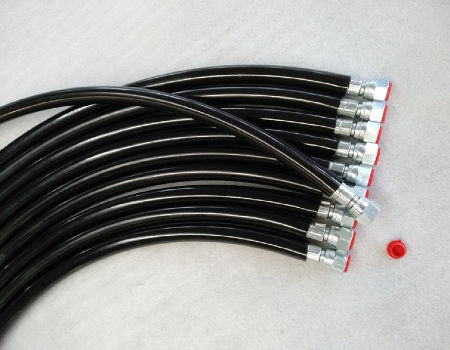
Common Procurement Misconception: Pressure Rating ≠ Suitability for Ultra-High Pressure Extreme Conditions
Many industrial procurement and maintenance personnel habitually apply the selection logic of ordinary hydraulic hoses when choosing ultra-high pressure hoses, assuming that as long as the nominal pressure rating reaches 150MPa, it can be used directly. However, after actual deployment, it is quickly discovered that many ordinary high-pressure hoses burst or tear their inner layers after only a few dozen pulses under the extreme pressure of 150MPa. This not only causes large-scale leakage of expensive hydraulic media but may even threaten the personal safety of on-site operators.
150MPa ultra-high pressure resin hoses are designed for extreme conditions far exceeding those of conventional hydraulic systems: water jet cutting, high-pressure water descaling, oilfield production enhancement operations, heavy-load testing of large equipment, etc. In these scenarios, the medium flows within the hose at extremely high speeds, accompanied by high-frequency pressure surges and drops. Ordinary steel-reinforced high-pressure hoses simply cannot meet the performance requirements of this ultra-high pressure level. Forcibly replacing them will only bring extremely high safety and downtime risks.
Special composite structure design, fundamentally adapted to ultra-high pressure operating logic
A qualified 150MPa ultra-high pressure resin hose is a special multi-layer composite system designed entirely for ultra-high pressure operating conditions. The inner layer uses high-strength special engineering resin, which can withstand the high-speed erosion of the medium at 150MPa and is suitable for various transport media such as water, emulsions, and some special chemicals, without issues like inner layer swelling or tearing. Its extremely smooth inner wall significantly reduces resistance loss during ultra-high pressure medium flow.
The middle high-strength reinforcing layer uses high-modulus aramid fiber or special synthetic fiber, formed using a precise cross-winding process. Each fiber has uniform tension, and under the rated working pressure of 150MPa, the hose elongation can be controlled within 2%, completely eliminating the problems of significant elongation and vibration that occur with ordinary high-pressure hoses under pressure. The outer layer uses a highly wear-resistant and aging-resistant special polyurethane material, which will not easily break even after repeated dragging and contact with sharp objects at the work site, effectively protecting the internal high-strength reinforcing layer from damage.
Lightweight and highly safe, significantly reducing overall on-site operating costs
In many ultra-high pressure operation scenarios, traditional all-steel wire spiral ultra-high pressure hoses are not only heavy, making on-site dragging and movement extremely laborious, but also prone to operator fatigue during long-term operation. Furthermore, once the outer layer of the steel wire hose is damaged, the internal steel wires are easily corroded, directly affecting the overall pressure-bearing safety.
The 150MPa ultra-high pressure resin hose weighs only 1/3 of a steel wire hose of the same pressure rating, making on-site deployment and movement highly flexible. A single person can complete long-distance pipeline laying operations, significantly improving on-site construction efficiency. Moreover, each hose undergoes pressure testing at twice the working pressure and tens of thousands of pulse fatigue tests before leaving the factory to ensure long-term stable operation under rated conditions. With targeted selection guidance, such as prioritizing high-flexibility small-diameter models for waterjet cutting scenarios and high-wear-resistant long-length models for oilfield high-pressure operations, the overall service life of the hose can be increased by more than 2 times, significantly reducing unplanned downtime and safety hazards in ultra-high pressure scenarios.