Offshore Platform Mud Transportation: A Flexible Pipeline Test Several Times More Severe Than on Lan
2026-10-15 14:33:17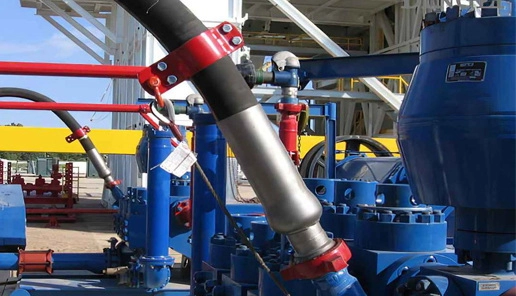
Unlike onshore drilling sites, offshore drilling platforms operate in a marine environment characterized by high salt spray, high humidity, and strong ultraviolet radiation. They must also withstand continuous pipeline displacement caused by wave action and platform heave. Furthermore, the compact space and complex piping of the platform mean that ordinary onshore drilling hoses often crack due to salt spray corrosion within months of installation. Repeated tension from platform movement also causes premature fatigue failure of joints. More importantly, mud leaks on the platform not only directly halt drilling but can also trigger marine environmental compliance risks, resulting in hefty penalties. Therefore, drilling platform mud transportation hoses must be specifically reinforced for the unique operating conditions of offshore platforms from the initial design stage, rather than being a simple migration and adaptation of onshore hoses.
Multi-layered composite structure with directional reinforcement, adaptable to complex marine corrosive environments
The walls of these hoses feature a targeted three-layer composite structure: the inner layer uses a special synthetic rubber resistant to oil, water-based/oil-based mud, and seawater corrosion, ensuring no swelling or wear-through issues even after long-term transport of high-pressure mud containing rock cuttings; the middle layer is a multi-layered high-strength steel wire reinforced skeleton, capable of withstanding the pulse impact of high-pressure mud while maintaining sufficient flexibility to absorb displacement caused by platform swaying; the outer layer is specially formulated with salt spray, UV resistance, and seawater immersion resistance additives, preventing rapid aging and cracking even after long-term exposure to open decks, salt spray corrosion, and intense sunlight. Versions installed in wave-splash zones have an additional seawater immersion resistant protective layer.
Dynamic compensation design to absorb platform swaying and tidal displacement
Floating drilling platforms rise and fall with the waves, rolling and pitching, resulting in continuous relative displacement between the piping systems. Rigid pipes cannot absorb this repeated displacement, easily leading to weld cracking and flange misalignment. The drilling platform mud delivery hoses are designed with specific allowances for axial expansion, lateral offset, and angular deflection. Installed at the top and bottom of the riser, pump outlet, and manifold sections, they essentially add multiple movable "elastic joints" to the rigid pipe string. This naturally absorbs all displacement caused by platform swaying, eliminating the need for complex mechanical compensation devices and ensuring the entire mud pipeline remains sealed and stable even when floating.
Leak-proof design safeguards marine environmental safety.
To meet the stringent environmental requirements of offshore platforms, these hoses employ a double-seal structure at the joints, combined with a high-strength integral crimping process to prevent joint slippage and leakage under high pressure. Hose used in critical locations also features a leak warning layer. If the inner layer shows wear and leakage, the warning channel in the middle layer will display a visible leak indication at the joint. Maintenance personnel can detect potential hazards and replace the hose before a complete burst, completely preventing large-scale mud spills into the sea and building a solid defense for platform safety and marine ecological protection.